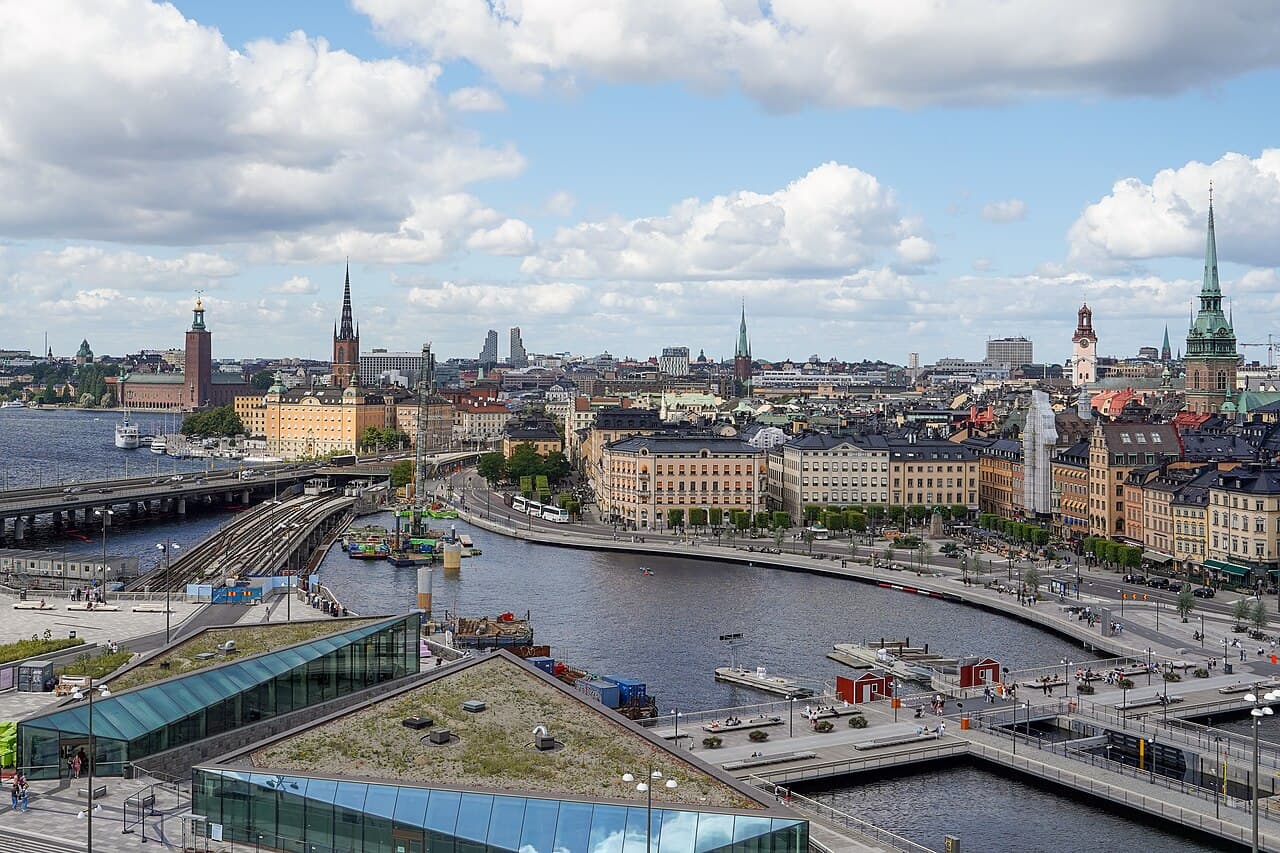
Stockholm's historic core makes more sense as a set of overlapping institutions than as a preserved medieval scene. The Royal Palace carries traces of defence, monarchy and government despite its eighteenth-century form. Storkyrkan grew through medieval and Baroque phases. Riddarholmen Church shifted from Franciscan church to royal burial site, while the former Stock Exchange building on Stortorget now houses the Nobel Prize Museum.
This guide is a method for reading those layers. It does not prescribe a walking route or promise access to interiors. Use exact official pages to establish what a building became, then look for changes in material, façade, setting and civic function from public space.
At a glance
Start here
- Read each building as a sequence of uses rather than a single architectural date.
- Separate medieval institutional origins from later façades and interiors.
- Compare monarchy, church, burial, trade and museum functions across a compact area.
- Verify current interior access because active institutions and restoration can limit entry.
01
Replace the postcard with a layered city
Gamla Stan's narrow streets can encourage a vague old-town impression. A stronger reading begins by naming institutions. A fortress and royal residence asserted power. A cathedral shaped religious and political ceremony. A monastic church became a royal burial church. A stock-exchange building represented commerce before becoming a museum about Nobel-recognised work. The district's significance comes from these changing relationships.
For each place, record four things: original purpose, major rebuilding, present function and one visible clue. The exercise prevents a later façade from erasing an earlier institution. It also keeps public-space observation worthwhile when an interior is unavailable. What looks stylistically unified from a distance may contain centuries of adaptation.
- Institution: who controlled or used the place?
- Change: which rebuilding altered its appearance?
- Function: what does it do now?
- Evidence: what can be observed without inventing a story?
02
Read the Royal Palace as power rebuilt
The official palace history distinguishes tradition from certainty. It discusses debated evidence for an early timber structure and a more secure medieval fortress history, then follows the site through expansion, the destructive fire of 1697 and the occupation of the new palace in 1754. That sequence matters: the present exterior does not make the site's political history purely eighteenth century.
Look at the palace as a statement about state order after catastrophe. The official account interprets the façades differently, linking sides of the building to royal and governmental meanings. Even without accepting architecture as a simple code, notice how scale, symmetry, courts and proximity to the cathedral organise authority. Keep debated early claims labelled as debate rather than converting tradition into fact.
- Separate the long-lived site from the date of the current palace.
- Treat the 1697 fire as a break that enabled a new architectural statement.
- Notice the palace's relationship to surrounding civic and religious buildings.
03
Read Storkyrkan beneath its later exterior
Storkyrkan stands between the Royal Palace and Stortorget and has served Stockholm's religious and political life since the medieval period. The parish's history page records the church in writing in 1279, describes early brick construction completed in the early fourteenth century and follows later medieval enlargement. The Baroque exterior came much later, in the eighteenth century.
That chronology supplies the central visual lesson: an exterior can coordinate with a later city while enclosing a substantially older spatial history. If the church is open under its current arrangements, objects such as the St George and the Dragon sculpture and the Parhelion painting add further layers of civic memory. If it is not, the placement beside palace and square still reveals the cathedral's institutional importance.
- Do not date the whole church from the façade alone.
- Compare the cathedral's position with the palace and market square.
- Check the parish visitor page for current access before depending on an interior.
04
Read Riddarholmen Church as reused memory
Riddarholmen Church began as part of a Franciscan foundation established in the thirteenth century. The Royal Palaces authority traces its completion around 1300, its survival after the Reformation and its later role as the burial church of Swedish monarchs. Royal tombs and the arms of the Order of the Seraphim changed the building's commemorative meaning without erasing its monastic origin.
This is a useful counterpoint to the Royal Palace. One site presents ongoing royal and governmental function; the other stores dynastic memory in a repurposed church. The official page carried a current restoration notice during research, so do not assume interior entry or an unobstructed exterior. The historical reading remains valid even when restoration changes what can be seen.
- Track the shift from monastery to royal burial church.
- Distinguish the building's medieval fabric from later memorial additions.
- Check restoration and opening information directly before a planned interior visit.
05
Read Stortorget through civic reuse
At Stortorget, the Nobel Prize Museum occupies Börshuset, the former Stock Exchange building. The museum opened in 2001 and uses the building to interpret the Nobel Prize, laureates and ideas that changed the world. That modern use adds another historical layer to a square too often treated only as a colourful façade composition.
Ask what it means for a building associated with exchange and civic representation to become a museum about international intellectual recognition. The point is not to claim a direct historical continuity between those functions. It is to notice that historic cores remain active through institutional reuse. Check the museum's current visitor information separately if an interior visit matters.
- Identify Börshuset as a former exchange building before reading it as a museum.
- Separate the history of the building from the history narrated inside it.
- Use the square to compare commercial, religious and royal institutions nearby.
06
Compare edges instead of collecting landmarks
The most revealing views occur where institutions meet. Between Storkyrkan and the palace, religious ceremony and royal power occupied adjacent ground. Around Stortorget, civic and commercial functions sat within reach of both. Across toward Riddarholmen, the burial church set dynastic memory in a somewhat different urban setting. These relationships are more informative than the number of façades photographed.
Pause at an edge and describe only what the sources and visible fabric support. Note changes in scale, material, street width, enclosure and approach. Avoid assigning a precise date to every wall without evidence. The official histories establish major phases; observation shows how those phases now coexist. Together they create a disciplined reading without turning architectural interpretation into certainty.
- Compare building scale with the width of the space before it.
- Look for transitions between ceremonial, commercial and residential streets.
- Keep an observation separate from a sourced historical claim.
07
Make a four-line record for each place
A compact note is enough: name the institution, give one secure historical transition, record one visible feature and write one unresolved question. For the palace, the transition might be from the 1697 fire to the eighteenth-century rebuilding. For Storkyrkan, it might be the contrast between medieval development and Baroque exterior. For Riddarholmen, it could be the shift from friary church to royal memorial.
Finish by checking the unresolved question on an exact official page rather than a generic destination overview. If a source reports debate, restoration or changing access, preserve that uncertainty in the note. The goal is not to master every date during one visit. It is to leave with a defensible account of how Stockholm's core kept being rebuilt, reassigned and interpreted.
- Institution and present function.
- One secure transition.
- One observed feature.
- One question to verify later.
Useful answers
Reader questions
Is Stockholm's Royal Palace a medieval building?
The site has a medieval fortress history, but the present palace followed the 1697 fire and was occupied in 1754. Describe the site as historically layered rather than assigning one date to everything visible.
Sources: Royal PalacesWhy does Storkyrkan look newer than its origins?
The church developed through medieval building phases, while its Baroque exterior was created in the eighteenth century. The outer treatment therefore does not reveal the full age of the institution or fabric.
Sources: Stockholm Cathedral Parish; Stockholm Cathedral ParishWhat was Riddarholmen Church before it became a royal burial church?
It originated in a Franciscan foundation from the thirteenth century. After the Reformation it survived and gradually acquired its royal burial and memorial role.
Sources: Royal PalacesCan I assume these historic interiors are open?
No. They are active institutions, visitor sites or restoration environments with changing access. Read the exact official visitor page shortly before going and keep the exterior institutional reading as a complete alternative.
Sources: Stockholm Cathedral Parish; Royal Palaces; Nobel Prize MuseumRead the evidence
Sources and further reading
These sources support the relevant sections above. Plans and comparisons are editorial suggestions. Check operators for current arrangements.
- The Royal Palace history ↗Royal Palaces · Accessed 14 September 2026
Debated early origins, medieval fortress development, the 1697 fire, the 1754 palace and official façade interpretation.
- Visiting Stockholm Cathedral ↗Stockholm Cathedral Parish · Accessed 14 September 2026
The cathedral's position, broad history, civic role and significant interior objects.
- Storkyrkans historia ↗Stockholm Cathedral Parish · Accessed 14 September 2026
First written record, medieval brick construction and expansion, and the later Baroque exterior.
- The Riddarholmen Church history ↗Royal Palaces · Accessed 14 September 2026
Franciscan foundation, medieval completion, post-Reformation survival, royal burials, memorials and restoration notice.
- About Nobel Prize Museum ↗Nobel Prize Museum · Accessed 14 September 2026
The museum's location in Börshuset at Stortorget, its 2001 opening and current interpretive purpose.