Stockholm's metro art is not a conventional collection installed in spare wall space. Region Stockholm describes art at 94 of the network's 100 stations, involving more than 250 artists. In many places, particularly rock-cut stations, colour, relief, mosaic, tile and sculptural treatment work with the architecture itself.
The result is often promoted as a very long art exhibition, but its more interesting identity is public infrastructure shaped by art. Permanent commissions must survive transit conditions and help make stations distinct; temporary displays create a changing programme; new works are planned alongside architects and engineers.
At a glance
Start here
- Metro art is part of station design and public space, not only decoration added afterward.
- Rock-cut architecture allowed artists to work with exposed surfaces and entire spatial sequences.
- Durability, maintenance and passenger orientation influence artistic decisions.
- Temporary exhibitions and new lines keep the programme open rather than historically fixed.
01
Art belongs to the infrastructure
Region Stockholm administers art across metro, commuter rail and other public-transport environments. Its metro overview says 94 of 100 stations contain art and credits more than 250 artists. Scale alone is not the important point. Because the work sits in a transport system, it shares space with entrances, platforms, signs, passenger flow, lighting and materials chosen for heavy use.
That context changes how a work functions. It may identify a station, mark a transition, create memory on a repeated commute or reshape the experience of a rock cavern. The audience does not opt into a museum visit; it encounters art while travelling. Publicness here means routine exposure, but it also means the work must coexist with operational changes and many different uses of the station.
- Read the platform and artwork as one environment.
- Notice how signs and passenger movement interact with visual elements.
- Distinguish a permanent station commission from a temporary display.
02
Rock-cut stations expanded the canvas
The official history of the collection highlights the Blue and Red line stations where exposed or treated rock creates cave-like interiors. Instead of concealing every excavated surface behind a conventional finish, designers and artists could use the cavern as a spatial field. Colour and form extend across walls and ceilings, making the journey from escalator to platform part of the work.
This approach allows a station to be experienced sequentially rather than as one framed image. A colour may guide the eye through the volume; a sculptural or painted element can change as the passenger moves; the rawness of rock can remain visible beside deliberate intervention. Photography often compresses that relationship, so the better question on site is how the artwork changes movement and scale.
- Look up and behind, not only at platform-level panels.
- Compare treated rock with smooth architectural surfaces.
- Follow how the work unfolds from entrance to platform.
03
Materials must endure a transport environment
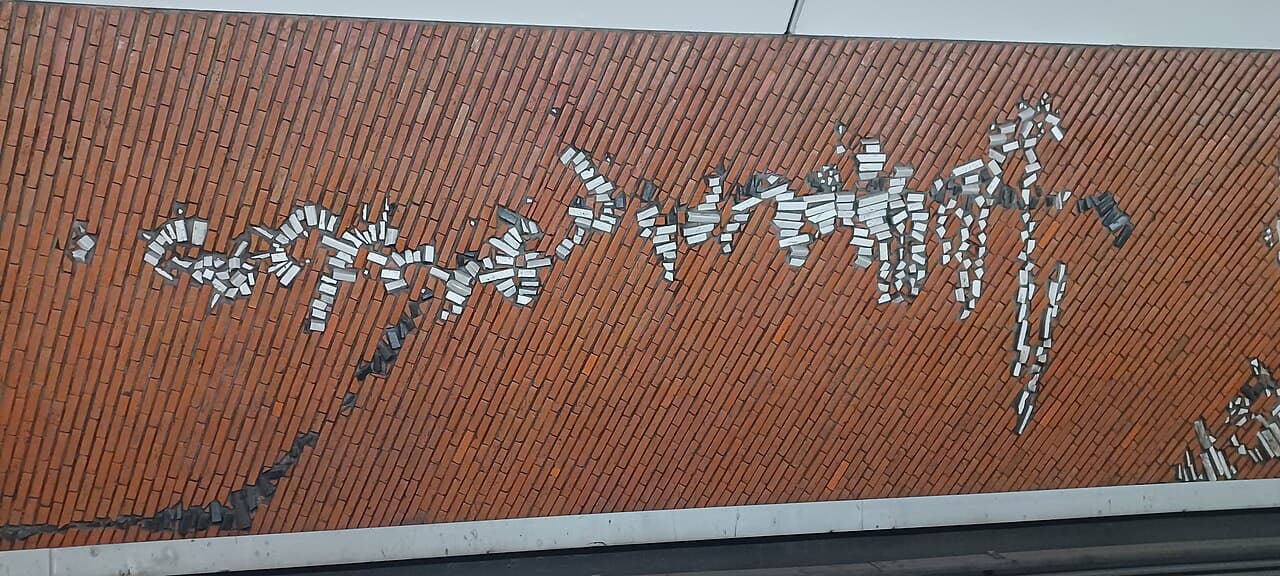
The regional overview describes media including painting, sculpture, mosaics, tile, glass, relief and other integrated techniques. In a metro, material is never only an aesthetic choice. Surfaces face vibration, dust, cleaning, moisture, touch and continuous public use. Maintenance teams must be able to preserve both artwork and functioning station around it.
Durability does not require visual sameness. It can encourage close cooperation among artist, engineer, architect and fabricator so that fixing methods, lighting and surface treatment become part of the commission. When observing a work, look for joints, transitions and the way it meets floors, walls or service elements. Those practical decisions reveal how an artistic idea became infrastructure.
- Identify whether colour is painted, tiled, embedded or lit.
- Notice edges where artwork meets operational equipment.
- Consider cleaning and repair as part of long-term public stewardship.
04
Station identity can support orientation
Region Stockholm presents art as a way to make public environments meaningful, recognisable and easier to remember. A distinct palette, theme or spatial treatment can give passengers another cue beyond the station name. That does not replace official signage or live travel information, but it can help form a mental map of repeated journeys.
The civic argument is equally important. Commissioning art for everyday transport places cultural experience outside ticketed galleries and distributes it through shared infrastructure. Access is still shaped by the transport system and individual needs, so the word public should not be confused with universally effortless. It describes an institutional commitment to place art in ordinary collective space.
- Use artwork as a memory cue, never as a substitute for destination signs.
- Compare how two stations develop distinct identities.
- Ask what changes when cultural commissioning happens in daily infrastructure.
05
Temporary exhibitions create another timescale
Alongside permanent commissions, Region Stockholm operates temporary exhibition spaces at selected stations. Its programme page traces this practice to the 1990s and describes a curatorial and selection process that has produced hundreds of exhibitions. These displays give contemporary artists and changing subjects a presence within the network without redesigning an entire station.
Temporary work should be approached as genuinely temporary. A display named in an old article may have been replaced, and even a current programme can change. Use the region's live art pages to see what is installed, then distinguish that exhibition from the permanent architectural treatment around it. The contrast reveals two curatorial speeds: infrastructure measured in decades and displays measured in shorter cycles.
- Confirm the present exhibition on the official programme page.
- Separate temporary panels or cases from integrated station art.
- Notice how a changing display addresses passengers who did not seek it out.
06
New stations start planning art early
For new metro extensions, the regional programme describes artists working in relation to architecture, engineering and the identity of future stations. Art is considered during development rather than assigned only after technical design is complete. That gives commissions opportunities to affect surfaces, light, movement and memorable spatial features at a fundamental stage.
Opening dates and construction conditions can change, so this article does not promise access to any future station. The durable point is the planning method. Early collaboration treats art as one system among structure, circulation, maintenance and orientation. It also makes the future network part of an ongoing collection rather than a replica of famous twentieth-century stations.
- Treat future station dates as live project information.
- Look for evidence of integrated design rather than an applied object.
- Expect new commissions to respond to their own sites.
07
View the art as a passenger first
A thoughtful viewing method respects the station's primary transport role. Choose a small number of stations on a journey you already need, stand clear of circulation paths and allow trains to move before composing an image. Region Stockholm states that personal photography is permitted, but that permission does not remove the need to follow signs, staff instructions and normal passenger etiquette.
SL maintains an English art-walk page, but it rendered only a client-side shell during this research, so no tour schedule is claimed here. Open the live page in a browser if an organised walk interests you. Whether travelling independently or with a guide, focus on one comparison, such as cave treatment, station identity or temporary versus permanent art, instead of trying to collect the entire network.
- Keep platforms, doors, stairs and escalators clear.
- Use official live journey information for transport decisions.
- Select a visual question rather than attempting all art stations.
Useful answers
Reader questions
How many Stockholm metro stations have art?
Region Stockholm's current pages state that 94 of the system's 100 stations contain art and associate the collection with more than 250 artists. These are operator figures accessed in September 2026.
Sources: Region Stockholm; Region StockholmIs all Stockholm metro art permanent?
No. Integrated and permanent station works coexist with a curated temporary exhibition programme at selected stations. Check the official programme for what is currently displayed.
Sources: Region Stockholm; Region StockholmMay I photograph the metro art?
Region Stockholm says personal photography is allowed. Remain a passenger first: obey signs and staff, do not obstruct circulation, and check separate requirements for commercial or organised work.
Sources: Region StockholmCan I book an English metro art walk?
SL has a current English art-walk endpoint, but it did not expose schedule details in this research fetch. Open the official page in a browser and verify the latest language, date and participation information there.
Sources: SLRead the evidence
Sources and further reading
These sources support the relevant sections above. Plans and comparisons are editorial suggestions. Check operators for current arrangements.
- Konsten i kollektivtrafiken ↗Region Stockholm · Accessed 14 September 2026
Current network figures, art forms, cave-station context, materials, public role and collection administration.
- Världens längsta konstutställning ↗Region Stockholm · Accessed 14 September 2026
Current station and artist figures, media range, spatial examples and personal-photography policy.
- Konstväxlingar i tunnelbanan ↗Region Stockholm · Accessed 14 September 2026
Temporary exhibition history, selected stations, curatorial process and changing programme.
- Nya gestaltningar i tunnelbanan ↗Region Stockholm · Accessed 14 September 2026
Early artist involvement in new stations, coordination with architecture and engineering, orientation and material integration.
- Art walks ↗SL · Accessed 14 September 2026
The current official English endpoint for art walks; the fetched page was a client-side shell, so no schedule is derived from it.