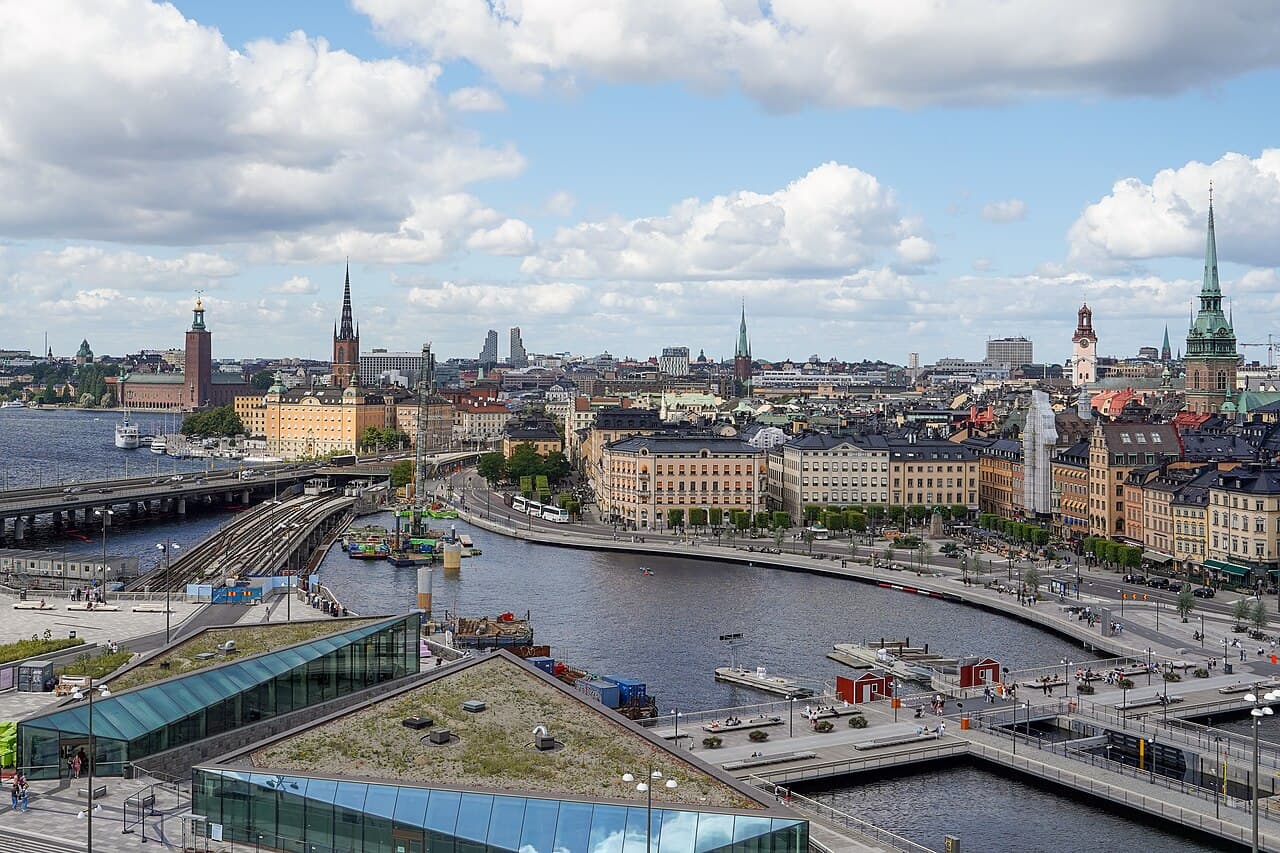
Stockholm City Hall is often reduced to its tower or the Nobel banquet. Yet the building was conceived as a municipal institution: a place for political work, administration, representation and public ceremony. Ragnar Östberg's architecture gives those functions a sequence of courtyards, halls, stairs and carefully integrated art.
Its strongest story is therefore not a single event. It is how a working city government turned architecture into civic theatre, then continued adapting that stage to council business, visits and internationally recognised ceremony.
At a glance
Start here
- The building emerged from a municipal competition and changed from a courthouse proposal into a city hall.
- Its architecture combines Swedish references with Renaissance, Baroque and Venetian ideas.
- Political work and ceremonial use are not separate stories; the building was designed to hold both.
- Guided access is subordinate to a working building, so room availability must be checked live.
01
A courthouse project became a city hall
Stockholm's rapid nineteenth-century growth increased the need for municipal premises. A competition was launched in 1902 for a courthouse and city hall, and Ragnar Östberg's proposal was selected for the city-hall part. The courthouse moved to another site, allowing the building on the former Eldkvarn plot to develop around municipal purposes instead of remaining a paired complex.
Construction ran from 1911 until the 1923 inauguration. That long gestation matters because City Hall was not the effortless expression of one complete idea. Programme, site and design evolved. The result uses monumental architecture to give a growing municipal organisation visible form at the water's edge.
- 1902 competition: courthouse and city hall were initially connected.
- The city-hall project remained on the Eldkvarn site.
- Construction and design development continued through 1923.
02
The architecture works by synthesis
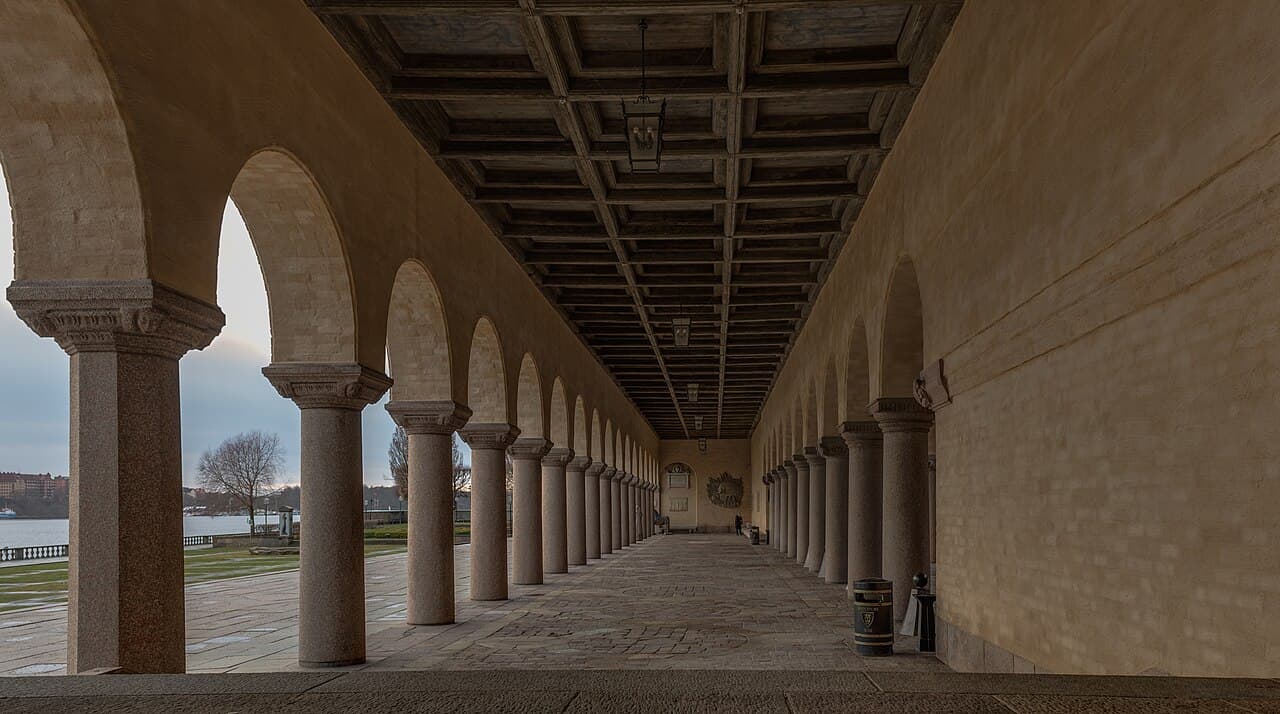
The official architecture account identifies Italian Renaissance and Swedish Baroque influences, National Romantic ideas and Venetian references in courtyards, colonnades and the ceremonial stair. Swedish brick, granite and marble make those imported and historical ideas materially local. The Three Crowns emblem adds another national reference to the skyline.
Calling the building eclectic is accurate but incomplete. Östberg did not merely attach styles as decoration; different references help organise arrival, enclosure, procession and civic symbolism. The waterside setting, open courtyard and sequence toward major halls turn movement into part of the architectural argument. Materials and artworks were designed to participate in that whole rather than operate as detachable ornament.
- Notice how the courtyard mediates between city and interior.
- Compare heavy brick surfaces with lighter arcades and water views.
- Read art, furniture and architecture as a coordinated programme.
03
Rooms turn movement into ceremony
City Hall's major interiors are not neutral containers. The Blue Hall creates a vast brick setting for gathering, while the Golden Hall uses an extensive mosaic programme to produce a very different visual intensity. The council chamber gives political deliberation its own architectural frame. Routes among them make arrival, ascent and entry legible as staged transitions.
The effect becomes clearer when visitors watch where attention is directed. A stair can slow the body and present the room ahead; a balcony or arcade can frame the water and city; a decorated wall can turn a reception into an image of civic identity. Architecture here does not guarantee unity, but it gives municipal occasions a shared physical script.
- Blue Hall: gathering and formal arrival.
- Golden Hall: mosaic spectacle and reception.
- Council chamber: political assembly within the ceremonial complex.
04
The monument remains a workplace
City Hall houses political offices and the council chamber while also supporting representation and events. That coexistence distinguishes it from a monument preserved after its original use disappeared. Decisions are still made within an architectural setting built to express the authority and identity of Stockholm's municipality.
The working function also explains visitor limits. Rooms may be needed for municipal business or events, and the official tour page warns that access can change at short notice. That is not an inconvenience detached from the building's history; it is evidence that the institution remains active. A tour sees the civic stage around its continuing use, not after that use has ended.
- Separate municipal work from ceremonial events, then notice where they overlap.
- Treat room closures as a consequence of active use.
- Avoid describing City Hall as if it were only a museum.
05
The Nobel banquet adds a global layer
The Nobel Prize award ceremonies occur elsewhere, but the banquet is held at Stockholm City Hall. The Nobel organisation's menu archive identifies the Blue Hall as the banquet setting and documents the long tradition of menus and table design. This event makes a municipal interior part of an international ritual attached to science, literature, peace and economics.
That association can overshadow other functions, so read it as one powerful layer. The room was not created as a free-standing Nobel attraction, and the building continues to serve city government. During the banquet, architecture, food, procession and seating convert civic space into a broadcast ceremonial image. On an ordinary day, the same room returns to the wider operational life of City Hall.
- Distinguish the award ceremony from the City Hall banquet.
- Read the banquet as a temporary ceremonial transformation.
- Keep the municipal identity visible beneath the global event.
06
Public access remains conditional
The official visitor information says the interior is seen on guided tours. Because City Hall is a workplace and event venue, a scheduled tour does not guarantee that every named room will be included. The venue can cancel tours or close spaces when activity in the building requires it. Exact schedules and languages belong on the live booking page, not in a durable feature.
This condition can improve how the building is understood. Instead of treating a missing room as proof that the visit failed, use the available sequence to examine materials, thresholds and institutional purpose. If one interior is essential, ask the venue before booking while accepting that operational needs can still intervene. The exterior and courtyard provide a different, complete reading of mass, water and city.
- Use the official tour page for current booking and language details.
- Do not promise a particular room.
- Keep an exterior architectural question as a valid alternative.
07
Read City Hall at four scales
Begin at the urban scale: tower, waterfront, approach and relation to Stockholm's silhouette. Move to the institutional scale by asking where officials work, council meets and guests gather. At the room scale, notice how stairs, surfaces and artworks organise attention. Finally, at the event scale, consider how an ordinary municipal interior changes during a council session, civic reception or Nobel banquet.
These scales prevent the familiar red-brick image from becoming a substitute for understanding. City Hall succeeds as a civic stage because its monumentality, daily work and special ceremonies occupy the same designed system. The tension is part of its value: public representation must coexist with offices, security, maintenance, political disagreement and a tour route that can never fully control the building.
- Urban: skyline, water and approach.
- Institutional: government, administration and representation.
- Room: materials, art and directed movement.
- Event: temporary transformation of civic space.
Useful answers
Reader questions
Was Stockholm City Hall always planned as one building?
The 1902 competition initially combined courthouse and city-hall needs. The courthouse was later assigned another site, while Ragnar Östberg's city-hall project developed on the former Eldkvarn plot.
Sources: Stockholm City HallIs the Nobel Prize award ceremony held in City Hall?
No. City Hall hosts the Nobel banquet, including its Blue Hall setting. The prize award ceremony is a separate event, so the two should not be described as if they occur in the same room.
Sources: Nobel Prize Outreach; Stockholm City HallCan I enter Stockholm City Hall without a tour?
The official visitor page states that interior visits are through guided tours. Current booking, language and access details should be checked there; the courtyard and exterior follow different arrangements.
Sources: Stockholm City HallWill a City Hall tour include every famous room?
Not necessarily. City Hall warns that rooms may close and tours may change or be cancelled because it is a working political and event building. Verify what matters, but keep expectations flexible.
Sources: Stockholm City Hall; Stockholm City HallRead the evidence
Sources and further reading
These sources support the relevant sections above. Plans and comparisons are editorial suggestions. Check operators for current arrangements.
- History ↗Stockholm City Hall · Accessed 14 September 2026
Municipal growth, the 1902 competition, the changed courthouse plan, Eldkvarn site, construction and inauguration.
- Architecture ↗Stockholm City Hall · Accessed 14 September 2026
Stylistic sources, courtyards, stair, national references, Swedish materials and integrated art.
- Function ↗Stockholm City Hall · Accessed 14 September 2026
Political offices, council chamber, civic representation, events and the Nobel banquet function.
- Guided tours ↗Stockholm City Hall · Accessed 14 September 2026
Guided-tour requirement for interiors and the possibility of room closures, changes or cancellations.